
The Hyphen Project
Hyphen is Namibia’s flagship green hydrogen project, being developed under a concession agreement in partnership with the Government of the Republic of Namibia (GRN) developing sub-Saharan Africa’s largest and only fully vertically integrated green hydrogen to green ammonia project.
Southern Corridor Development Initiative

Our project is located on ~4,000km2 of concessioned land within the Tsau ||Khaeb National Park, and in and around the local towns of Lüderitz and Aus. This is not, however, a one-off project, but the start of the scale-up of Namibia’s green hydrogen industry with Hyphen being the first project in the GRN’s Namibia’s Southern Corridor Development Initiative (SCDI), targeting the production of 3 million tonnes per annum (MPTA) of green hydrogen, ~10x the size of the project (equivalent to ~18 MTPA of green ammonia).
The SCDI is one of three hydrogen valleys that Namibia is planning to develop for the production of an estimated 15 MTPA of green hydrogen, set to establish Namibia as one of the largest producers of green hydrogen globally. Namibia’s green hydrogen industry is one element of Namibia’s broader green industrialisation strategy targeting the development of a green economy, including green mineral processing, manufacturing, etc. in support of the energy transition.
A key focus of both GRN and Hyphen is to optimise the design of the project and the broader SCDI strategy to minimise environmental impacts.
Production and export
We are targeting annual production of 1 MTPA of green ammonia by early 2030s, expanding to 2 MTPA by before mid 2030s. Hyphen is targeting the export of green hydrogen in the form of green ammonia to the demand centres of Europe, Japan and South Korea to help decarbonise those economies. Hyphen is also actively supporting the development of early local uses cases for green hydrogen in Namibia as part of the acceleration of Namibia’s broader green industrialisation ambitions.
We are planning to supply water to the town of Lüderitz to assist in meeting the growth in the town’s water demand linked to the establishment of the project without having to draw on existing water supply sources.
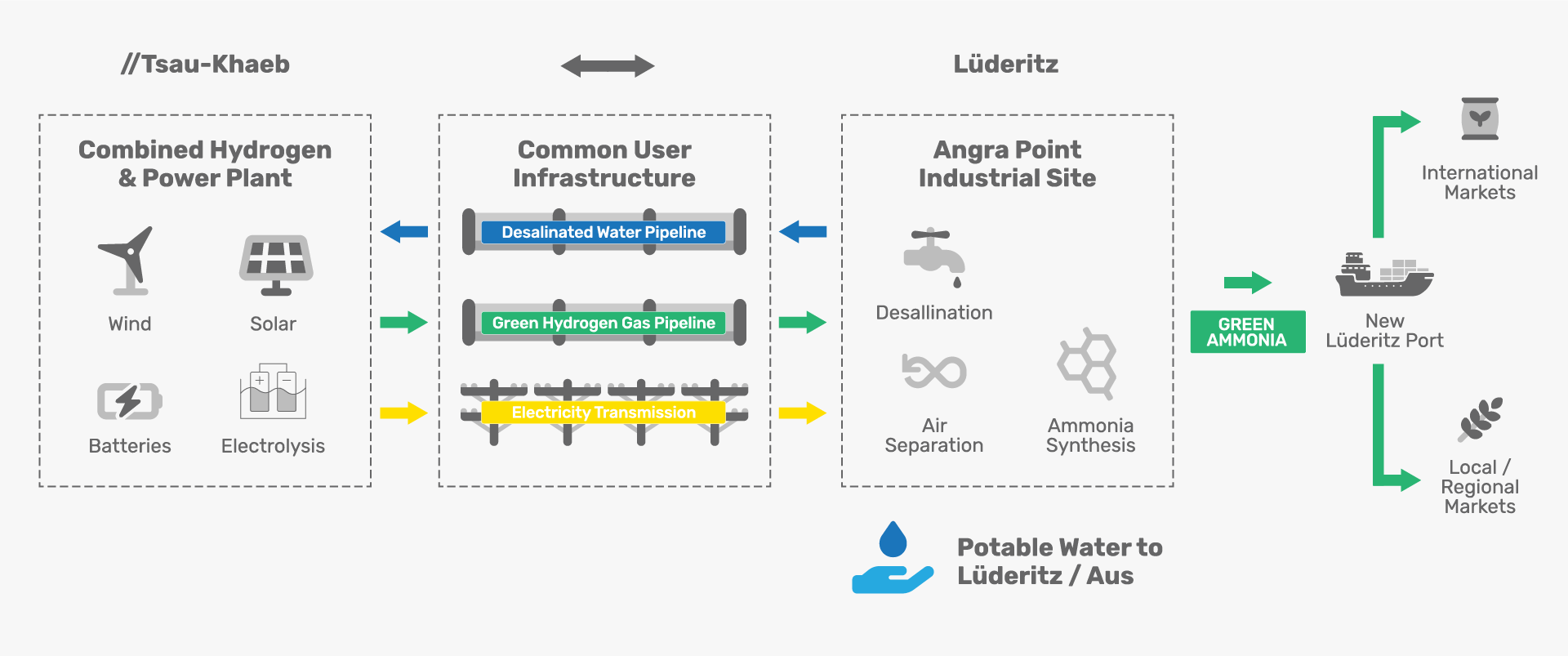

Project overview

Renewable Energy Capacity
Phase 1: 4.0GW renewable and 1.5GW electrolyser
Phase 2: 4.0GW renewable and 1.5GW electrolyser
Ammonia Output
Phase 1: 1,000,000 tonnes of ammonia per annum (early 2030s)
Phase 2: 1,000,000 tonnes of ammonia per annum (before mid 2030s)
Capex
More than US$10 billion for both phases
Construction jobs
Permanent jobs
The role of green hydrogen in the energy transition
The global demand for green hydrogen is growing.

Realising Africa’s green hydrogen ambitions will require billions of US$s of investment into renewable energy and green hydrogen projects annually. Unlocking this unprecedented scale of finance is only achievable if the private and public sector work together to bring projects to realisation as quickly as possible.
The EU, Korea and Japan are important future global demand centres for hydrogen and green ammonia produced and exported from regions like Africa. These economies lack the natural resources to produce the amount of green hydrogen needed to achieve national decarbonisation targets. They must partner with stable large scale supplier countries – like Namibia – to meet their green hydrogen needs.
Green hydrogen and its derivatives, such as green ammonia, are critical to achieving decarbonisation goals, providing a viable route to decarbonise sectors where direct electrification is not feasible – including fertilisers, shipping, steel production, refining, aviation, and heavy transport. Ammonia alone is projected to account for ~20% of global hydrogen consumption by 2050, underscoring its role as a scalable, tradeable carrier for hard-to-abate demand.
Green hydrogen costs remain above those of grey hydrogen today, but the gap is narrowing. Falling renewable electricity costs, electrolyser cost reductions at scale, and strengthening carbon pricing are together expected to bring green hydrogen to cost parity with grey hydrogen in favourable, low-cost renewable locations – such as Namibia – by around 2030, with global parity following as carbon pricing and infrastructure mature. Large-scale, vertically integrated projects like Hyphen, which combine low-cost renewables with export-ready ammonia infrastructure, are central to unlocking this cost trajectory.
What’s next?
The Hyphen project is advancing with front-end engineering design and is working to a clear and carefully designed timeline.


End of 2027
Final investment decision
Early 2030's
Completion of phase one (targeting annual production of 1 metric tonne per annum of ammonia).

Before mid 2030's
Completion of phase two (targeting annual production of cumulative 2 metric tonnes per annum of ammonia).
